AI: How do you coordinate one of the most significant technological revolutions of our time?
The House of AI Governance: Using Artificial Intelligence Safely and Intelligently
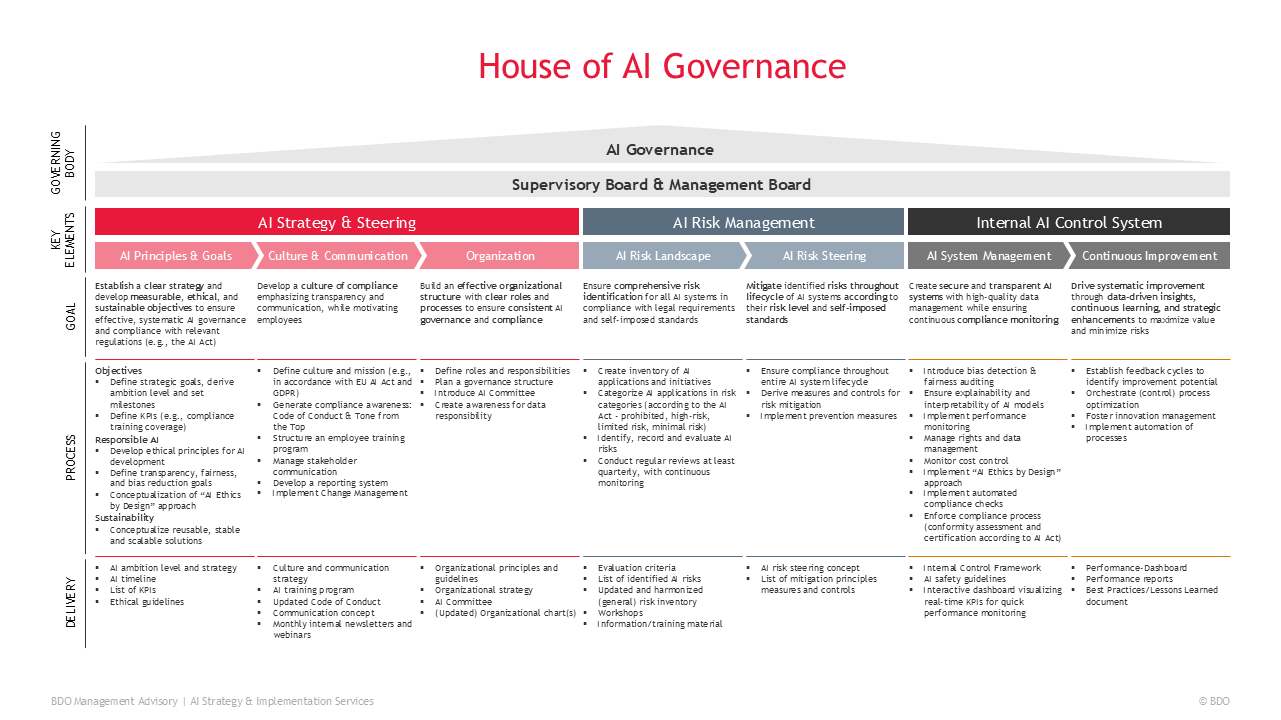
To meet high expectations despite limited resources, we have developed a dynamic framework that addresses this challenge directly: the House of AI Governance.
AI – Opportunities and Challenges
The dynamic development of artificial intelligence (AI) opens up first-time opportunities for value creation and transformation for companies, financial service providers and the public sector:
- Strategic competitive advantage: AI has fundamentally changed market expectations. Companies without an AI strategy are losing competitiveness, while pioneers are securing market advantages through efficiency and better customer experiences.
- Operational excellence: AI automation significantly reduces the need for manual effort, freeing up employees to focus on activities that add value.
- Accelerated innovation: Companies that implement advanced AI governance can shorten their innovation cycles and achieve a higher success rate when launching new products.
- Decision quality: Data-driven AI solutions improve business-critical decisions and minimise planning deviations in volatile markets.
- Cost reduction: Structured AI implementations lead to significant savings through optimised resource allocation and more efficient process design.
Recent studies show that the use of generative AI can increase employee productivity by an impressive 33% per working hour on average, which translates into significant efficiency gains for companies
(Source: Federal Reserve Bank of St. Louis, 2025).
While companies and financial institutions are already recognising the enormous transformative potential of AI systems, a crucial governance question is emerging: ‘How can we effectively use, manage and control a technology that simultaneously impacts different areas of the business?’
The application of AI brings with it multiple challenges:
- New market requirements – The market is changing faster than ever before, and AI offers new opportunities. This leads to increased expectations from customers, business partners and other stakeholders.
- Complexity due to regulatory requirements - National and supranational regulatory measures, such as MaRisk and the EU AI Act, generate new compliance requirements for AI users. Violations can result in both significant financial penalties and reputational damage.
- Security - Artificial intelligence can have unintended consequences, particularly with regard to data security and the protection of personal data. Compliance with the GDPR and other data pro-tection regulations is therefore a key challenge in the implementation of AI systems.
- Ethics - Algorithms can be biased, raising concerns about fairness and transparency in AI-supported decision-making processes. This requires the establishment of and adherence to ethical principles.
The challenge of modern AI governance lies not in the ‘if’ but in the ‘how’ of strategic embedding. Effective AI governance does not mean establishing another isolated and costly set of rules, but rather synergistic integration into existing management systems – an approach that unleashes innovative power while ensuring structured control and further development across all areas of the company.
This process raises key questions for companies
- How do we establish ethically acceptable AI applications that deliver concrete business results and contribute directly to value creation?
- How do we implement lean, pragmatic governance that effectively minimises risks while promoting innovation with measurable business success?
- Which efficient accountability structures for governance and regulation maximise business value with minimal administrative effort?
- How can we successfully integrate AI into our existing management systems in a secure and compliant manner in order to generate synergy potential while ensuring regulatory compliance?
The ‘House of AI Governance’ as a strategic framework
In our daily consulting practice, we witness first-hand the key challenge that companies face: 'We need to establish AI governance, but we have limited resources.' This pragmatic requirement calls for an efficient approach. Instead of setting up costly parallel structures, we recommend integrat-ing AI governance into existing management systems in a targeted manner. This approach not only reduces the initial implementation effort but also creates sustainable synergies.
Based on years of experience from numerous national and international customer projects and the resulting expertise, we have developed a dynamic framework that addresses precisely this chal-lenge: the House of AI Governance. To achieve a high degree of success in establishing new tech-nologies, it is crucial that AI governance is clearly defined, carefully managed and continuously monitored.
The ‘House of AI Governance’ establishes a structured framework that specifically promotes inno-vation and generates measurable business value. Our approach ensures compliance with regulatory requirements, defines clear responsibilities and seamlessly integrates ethical, legal and technical standards into existing structures. The overarching goal is to minimise risks while sustainably strengthening the trust of all stakeholders.