Date:
The speed at which AI is establishing itself in business and society is unprecedented. While its potential has long been recognised – from increased productivity and automated processes to completely new business models – practical experience shows that simply developing an AI strate-gy is not enough. Studies show that AI initiatives fail less because of technological hurdles and more because of a lack of structures and inadequate change management (source: The Impact of Artificial Intelligence Adoption on Organizational Decision-Making, Systems Journal, 2025).
The following challenges in particular can be identified for the successful introduction of AI:
- Lack of organisational foundation: Without defined roles, responsibilities and committees, there is no basis for making decisions, prioritising projects and effectively managing risks.
- Unclear procedures and processes: Without established decision-making and implementation processes, the integration of AI into existing value chains remains sluggish. Pilot projects remain in test mode and do not deliver any lasting benefits.
- Inadequate organisational preparation of the IT infrastructure: A lack of coordination between business processes and the technical basis prevents scaling and leads to friction losses.
This raises a key question for companies: How can companies not only plan AI strategically, but also integrate it successfully, sustainably and securely into their everyday business? The decisive factor is to bring together organisation, processes and people in such a way that obstacles are overcome, acceptance is fostered and the conditions for broad anchoring are created.
This is where the AI Adoption Framework comes in. It offers a clear five-step roadmap that helps companies successfully implement AI, from initial orientation to defining goals and structures to scaling: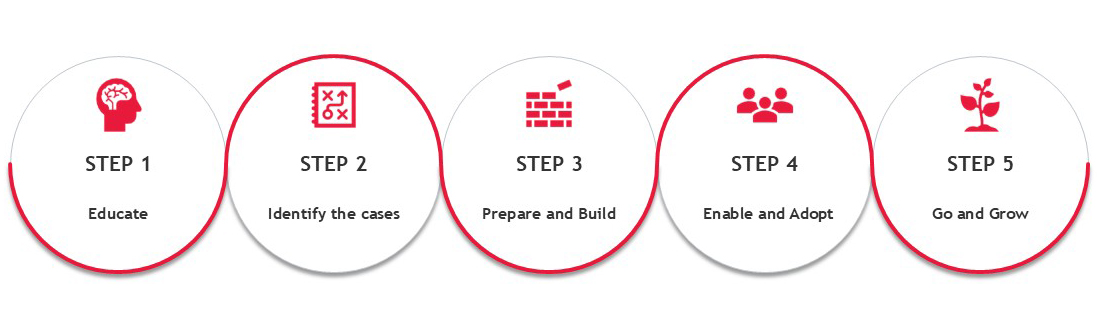
By consciously structuring the introduction of AI – from initial orientation to scaling – companies create the conditions for sustainable business success. In this way, AI becomes not a short-term experiment, but a key driver of efficiency, innovation and growth.